A community-based monitoring project for early detection of emerald ash borer in Alberta

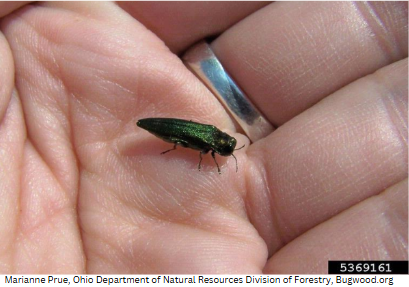
Your help is needed to monitor ash trees in your community and report signs and symptoms of declining health caused by an invasive wood-boring beetle that attacks and kills ash trees. The emerald ash borer (EAB), since it was detected in 2002 in eastern Canada and the United States, has killed tens of millions of ash trees across North America.

Municipalities and districts throughout Alberta have high numbers of ash planted along their street boulevards and open green spaces. These ash trees are now at risk of being lost and immediate action is needed.

Toledo, Ohio, before and after EAB infestation. This transformation took place in only 3 years, between 2006 and 2009

How can you help? Monitoring and Reporting is easy.

Free downloads of a Tree Track+Report Card and Posters are available here.

Once you are familiar with the symptoms and signs of EAB, you can watch for them in nearby ash trees. Reporting your specific concerns to the appropriate authorities will make a significant difference toward early detection and responsive containment efforts.

Collective efforts will give Alberta municipalities the best chance to slow its spread and protect our urban forests.

Why your support is vital for the future sustainability of our urban forests

Economic Considerations:

City trees are considered assets. They are as essential as our roads, underground services, and buildings in ensuring a safe, efficient, and resilient space for all people. Their ecoservices can be quantified: increasing property values, improved air quality, increased carbon storage and sequestration, reduced energy use, stormwater interception. Urban forest ecoservices are central to municipal climate adaptation and resiliency frameworks.

  • In Edmonton, approximations of public and private ash trees indicate over 180,000* public and private ash trees which represent roughly 20% of the entire urban forest. Their ecoservice value is $2.7 billion with replacement costs estimated at $390 million. Calgary has an estimated 250,000 public and private ash trees which represents 15% of their entire urban forest with an ecoservice value of $1.3 billion. These are 2021 figures. *Inventory efforts are ongoing in Edmonton to compile more accurate numbers on privately owned ash trees.

  • Tree nursery operations have made significant production investments in supplying ash tree species throughout Alberta for numerous municipalities. Recent commitments are estimated at $10 million

  • Rural ash shelterbelts shield homes, gardens, buildings and keep roads accessible from northwesterly winds, snow and overland flooding. They protect our rich agricultural soils and nutrients from erosion and severe droughts. Over 2 million ash trees have been planted in rural shelterbelt areas since the program started. These stands of ash trees are at risk

Ecological and Environmental Considerations:

Ash trees play a life-sustaining role in our cities. They are essential for:

  • supporting and sustaining biodiversity and resilient ecosystems

  • they provide food and shelter for hundreds of species of insects, including pollinators, birds, and mammals

  • support entire food webs and diverse microhabitats

  • provide essential ecoservices that sustain our quality of life by cooling our communities, cleaning the air we breath by absorbing carbon dioxide, harmful gases like nitrogen oxides and ozone, producing oxygen and are key to managing stormwater/overland flooding

Social well-being Considerations:

Ash trees are key in contributing:

  • to strengthening community connections by encouraging social interaction, fostering stronger relationships between neighbours and increasing feelings of safety

  • in the promotion of physical activity and recreation with measureable positive impacts to our mental well-being such as reduced stress and anxiety. This can lead to healthy heart rates and blood pressure

  • to beneficial impacts on road safety, reduce crime rates and incidences of violence

  • to beautifying our living spaces

Collaboration is key to protecting and sustaining our urban forests.

In addition to this community-based monitoring project, other volunteer opportunities include the City of Edmonton’s Urban Forest Ambassador Program and the City of Calgary’s Community Tree Ambassador Program.

Information